25 August, 2026 • 15 min read
How to Spot Fake Profiles in Random Video Chats Before You Answer
Most people hesitate for a split second before answering a random video chat request. It isn't because they dislike meeting new people—it is because they don't know who is on the other side of the screen. That tiny moment of uncertainty is completely reasonable.
Random video chat platforms make it possible to meet people from different countries, practice languages, make friends, or simply enjoy spontaneous conversations. At the same time, they can also attract fake profiles created by scammers, spammers, impersonators, and people with dishonest intentions.
While many platforms actively moderate users and remove suspicious accounts, no online community can completely eliminate fake identities before they appear. The good news is that fake profiles often leave clues long before a conversation becomes risky.
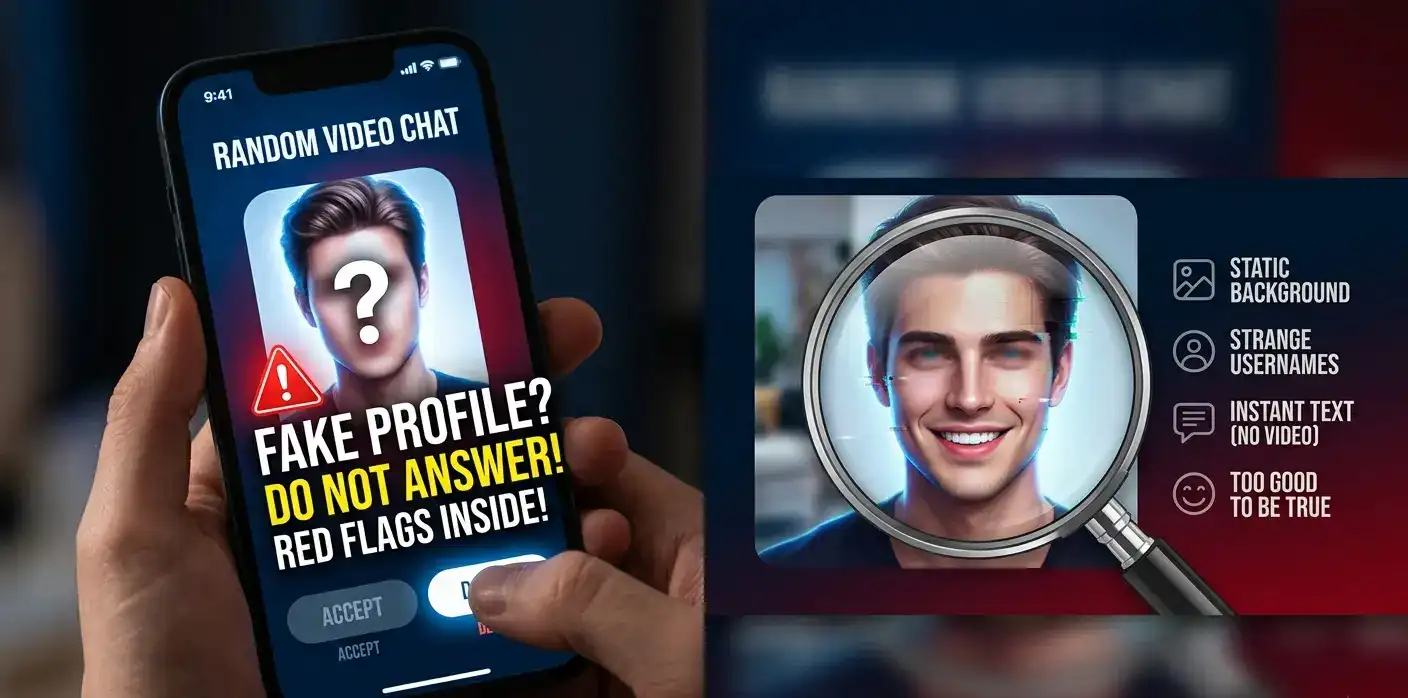
A profile photo that looks too polished, an incomplete bio, unusual conversation patterns, or an attempt to quickly move you to another messaging app can all indicate that something isn't right. Recognizing these warning signs doesn't require technical expertise—it simply requires paying attention to behavior rather than appearances.
This guide explains how to identify fake profiles before you answer a video call, why scammers rely on predictable psychological tactics, and what practical steps you can take to protect yourself. Whether you're looking for new friends, practicing English with strangers, or exploring alternatives to Omegle, learning these habits can help you enjoy genuine conversations while avoiding unnecessary risks.
What Are Fake Profiles in Random Video Chats?
A fake profile is an account that intentionally misrepresents the person behind it. Sometimes the profile uses stolen photographs, AI-generated faces, edited images, or fabricated personal details to appear trustworthy.
In other cases, the account may belong to a real individual who hides important information or pretends to have a different identity. The objective varies depending on the person behind the account. Some seek financial scams, while others collect personal information, spread spam, redirect users to external websites, or simply waste people's time.
Not every incomplete profile is fake, and not every anonymous user has harmful intentions. Many people value privacy and choose not to share personal details online. The difference lies in consistent patterns of deceptive behavior.
A genuine user may prefer anonymity but will usually communicate naturally, answer reasonable questions, and respect boundaries. Fake accounts often avoid direct questions, provide inconsistent stories, or pressure users into making quick decisions before trust has been established.
People naturally form impressions within seconds of seeing a profile. This means scammers can take advantage of the tendency to make quick judgments based on photographs, usernames, biographies, or other visual information. For that reason, profile verification should focus on behavior and consistency rather than appearance alone.
Research into online fraud has also shown that behavioral signals can be valuable when identifying fraudulent accounts. This is especially important on platforms where strangers can connect instantly and users may have very little context about one another.
Why Do People Create Fake Profiles?
Understanding the motivation behind fake profiles makes them much easier to recognize. Most fake accounts are not created randomly—they are designed to achieve a specific goal.
Financial scams remain one important reason. A scammer may spend days or even weeks building trust before asking for money, cryptocurrency investments, gift cards, or financial assistance. Others create fake identities to collect personal information, manipulate emotions, advertise external websites, or redirect users away from safer platforms.
Some fake accounts are also created for spam, harassment, impersonation, or disrupting conversations. The motivation can therefore vary considerably, but the resulting behavior often contains recognizable patterns.
Psychology also helps explain why these tactics succeed. Human beings naturally respond to familiarity, kindness, attention, and shared interests. When someone appears friendly and interested, people may lower their defenses without realizing it.
This is one reason scammers intentionally create believable personalities and emotionally engaging conversations. They may give excessive compliments, claim to share your interests, or reveal personal stories very quickly in an attempt to create a sense of familiarity.
Another growing concern is artificial intelligence. AI tools can generate realistic profile photos, convincing biographies, and natural-sounding text. This doesn't mean every attractive profile is fake, but it does mean users should evaluate consistency rather than appearance alone.
Genuine people can normally maintain consistent details through natural interaction. Fake identities often struggle when their stories are questioned or when conversations move beyond a prepared script.
Key Statistics: What Current Research Tells Us
Online safety research consistently shows that scammers often rely on psychology and behavioral manipulation rather than technology alone.
| Research Finding | Source |
|---|---|
| Nearly 60% of people who reported losing money in romance scams during 2026 said the scam began on social media. | FTC |
| Romance scammers commonly encourage users to move conversations off trusted platforms before asking for money. | FTC |
| Researchers have found that machine-learning techniques can identify many fraudulent dating profiles by analyzing behavioral patterns rather than photos alone. | Academic research |
How Can You Spot a Fake Profile Before Answering?
You rarely need advanced technology to identify suspicious accounts. Careful observation is often enough. Instead of focusing only on profile pictures, examine the overall consistency of the account.
| Green Flags | Red Flags |
|---|---|
| Natural profile photo | Professional model-like images only |
| Consistent profile details | Missing or contradictory information |
| Respectful conversation | Immediate personal questions |
| Comfortable staying on the platform | Pushes you to WhatsApp or Telegram immediately |
| Accepts boundaries | Tries to create urgency or emotional pressure |
One of the strongest warning signs is urgency. Scammers often encourage users to leave the platform quickly because trusted platforms may have moderation and reporting systems capable of detecting abusive behavior.
Be especially cautious when someone immediately asks for money, investments, cryptocurrency, gift cards, personal information, or an emergency favor. A stranger who creates emotional pressure before trust has developed deserves extra caution.
Expert Insights: What Online Safety Specialists Recommend
Cybersecurity experts and consumer protection agencies consistently recommend focusing on behavior rather than appearance. A convincing profile picture proves very little in an era where AI-generated images and stolen photographs are widely available.
Instead, watch for inconsistencies that build up over several conversations — does their story about where they live or what they do keep shifting, or do they dodge simple follow-up questions like "what's the weather like there right now?" Someone unwilling to answer basic, low-stakes questions is telling you more than any profile photo could.
The U.S. Federal Trade Commission recommends practical safety measures such as performing a reverse image search when a profile seems suspicious, refusing requests for money, discussing concerns with trusted people, and reporting suspicious accounts through the platform itself.
These recommendations are useful not only for dating platforms but also for random video chat communities where strangers interact for the first time.
Simple Safety Flowchart
Safety Checklist Before Answering
- Check whether the profile looks complete and consistent.
- Be cautious of photos that appear overly professional or unrealistic.
- Stay on the platform during the first conversation.
- Never share your phone number, address, workplace, or financial details immediately.
- End the conversation if someone pressures you emotionally or financially.
- Report suspicious accounts to help protect other users.
What Are the Biggest Warning Signs Before You Answer?
Although every fake profile is different, many follow surprisingly similar patterns. Learning to recognize these behaviors can help you make safer decisions before accepting a video call.
1. An Overly Perfect Profile
Professional-looking photos, vague biographies, and generic usernames aren't proof that an account is fake. However, they deserve closer attention when combined with other suspicious behavior.
Authentic users usually have small imperfections, varied interests, or conversational details that make their profiles feel natural. A profile that looks unusually polished but contains very little meaningful information should be evaluated carefully.
2. Contradictory Information
Another common indicator is inconsistency. Perhaps the profile says someone lives in Canada, but they later claim to be in Australia. Maybe they mention working as a teacher and later describe a completely different career without explanation.
Genuine people can make mistakes, especially in casual conversations. Repeated contradictions, however, can suggest that the person is maintaining a fabricated identity.
3. Immediate Requests to Leave the Platform
Users should also be cautious when someone tries to move the conversation away from the platform almost immediately. Requests such as "Let's talk on Telegram," "Add me on WhatsApp," or "Message me on another app instead" may seem harmless.
However, consumer protection agencies frequently identify moving conversations away from trusted platforms as a common tactic in online scams. Staying on the original platform during the early stages of a conversation can provide additional moderation and reporting protections.
4. Rushing Emotional Connections
Pay attention to the pace of the conversation as well. Healthy conversations develop naturally. Fake profiles may rush emotional connections by using excessive compliments, claiming instant friendship, or expressing unusually strong feelings after only a few minutes.
Building trust normally takes time. Someone who attempts to accelerate that process should be approached with caution.
Expert Insights: Why Specialists Recommend Focusing on Behavior
Cybersecurity professionals, psychologists, and consumer protection agencies consistently emphasize one important principle: judge behavior before appearance.
The Federal Trade Commission advises users to be skeptical whenever someone quickly asks to continue conversations on another platform, avoids reasonable verification, or introduces financial topics after developing emotional trust.
Psychologist Dr. Robert Cialdini's research on influence has helped explain why people can be persuaded by familiarity, similarity, and likability. While these tendencies help build genuine relationships, they can also create opportunities for manipulation.
Fake profiles may imitate trust-building behaviors by agreeing with everything you say, sharing exaggerated personal stories, or making you feel unusually important very early in the interaction.
Communication researchers also note that authentic conversations contain natural variation. Real people pause, ask thoughtful questions, occasionally misunderstand one another, and discuss a variety of topics.
Scam accounts, especially those using scripted responses or AI assistance, may instead produce repetitive compliments, generic answers, or conversations that seem strangely disconnected from what was actually said.
The practical takeaway is simple: trust consistency more than charm. A respectful, ordinary conversation with an imperfect profile is often safer than a flawless profile that immediately tries to influence your emotions or decisions.
Comparing Genuine Profiles and Suspicious Profiles
| Behavior | Likely Genuine Profile | Potential Fake Profile |
|---|---|---|
| Profile details | Consistent and realistic | Vague, incomplete, or contradictory |
| Conversation | Balanced and natural | Scripted, repetitive, or overly flattering |
| Personal questions | Asked gradually | Asked immediately |
| Moving to another app | Comfortable staying on the platform | Pushes to WhatsApp or Telegram quickly |
| Emotional connection | Develops naturally | Claims instant friendship or affection |
| Respect for boundaries | Accepts "no" politely | Uses pressure, guilt, or urgency |
| Identity verification | Comfortable with reasonable questions | Avoids or changes the subject |
Common Mistakes People Make
| Mistake | Why It Happens | Better Approach |
|---|---|---|
| Trusting attractive profile photos | First impressions influence judgment | Evaluate behavior instead of appearance |
| Moving to another app immediately | Curiosity or excitement | Stay on the original platform until trust develops |
| Ignoring small inconsistencies | Optimism bias | Ask polite follow-up questions |
| Sharing personal details too early | Desire to build rapport | Reveal information gradually |
| Feeling guilty about ending a chat | Social pressure | Trust your instincts and leave politely |
How to Stay Safe When Talking to Strangers Online
Spotting a fake profile is only one part of staying safe. Your own behavior can also reduce the amount of information a suspicious person can collect about you.
Protect Personal Information
Avoid sharing your home address, phone number, workplace, financial information, passwords, identification documents, or detailed daily schedule with someone you have just met online.
Remember that building trust does not require immediately revealing private information. Genuine friendships can develop gradually.
Stay on the Original Platform Initially
If you have just met someone, consider keeping the conversation on the platform where you originally connected. This allows you to use available moderation, blocking, skipping, and reporting tools.
Trust Your Instincts
If a conversation feels uncomfortable, confusing, rushed, or manipulative, you do not need to justify leaving. You can end the conversation, skip the user, block the account, or report suspicious behavior.
Your safety is more important than being polite to someone you have only just met.
Key Takeaways
- Fake profiles usually reveal themselves through behavior, not appearance.
- Scammers often create urgency, emotional pressure, or requests to move conversations elsewhere.
- AI-generated photos make visual verification alone unreliable.
- Protect your privacy by sharing personal information gradually.
- If something feels wrong, trust your instincts, leave the conversation, and report the account.
Conclusion: Stay Alert Without Missing the Fun
Random video chat can be a rewarding way to meet people from around the world, improve communication skills, and build genuine friendships. Most conversations are completely harmless, but a small number involve fake profiles designed to manipulate trust.
Learning to recognize behavioral warning signs before answering can dramatically reduce your chances of becoming a target. Instead of judging a profile by its photo alone, pay attention to consistency, honesty, communication patterns, and respect for boundaries.
Genuine users are usually comfortable with natural conversation and don't pressure you into quick decisions. Platforms such as Wakiee that combine moderation tools with user reporting can help create a safer environment, but your own awareness remains an important layer of protection.
By staying observant, protecting your personal information, and trusting your instincts, you can enjoy meaningful conversations with strangers while minimizing unnecessary risks.