23 April, 2026 • 9 min read
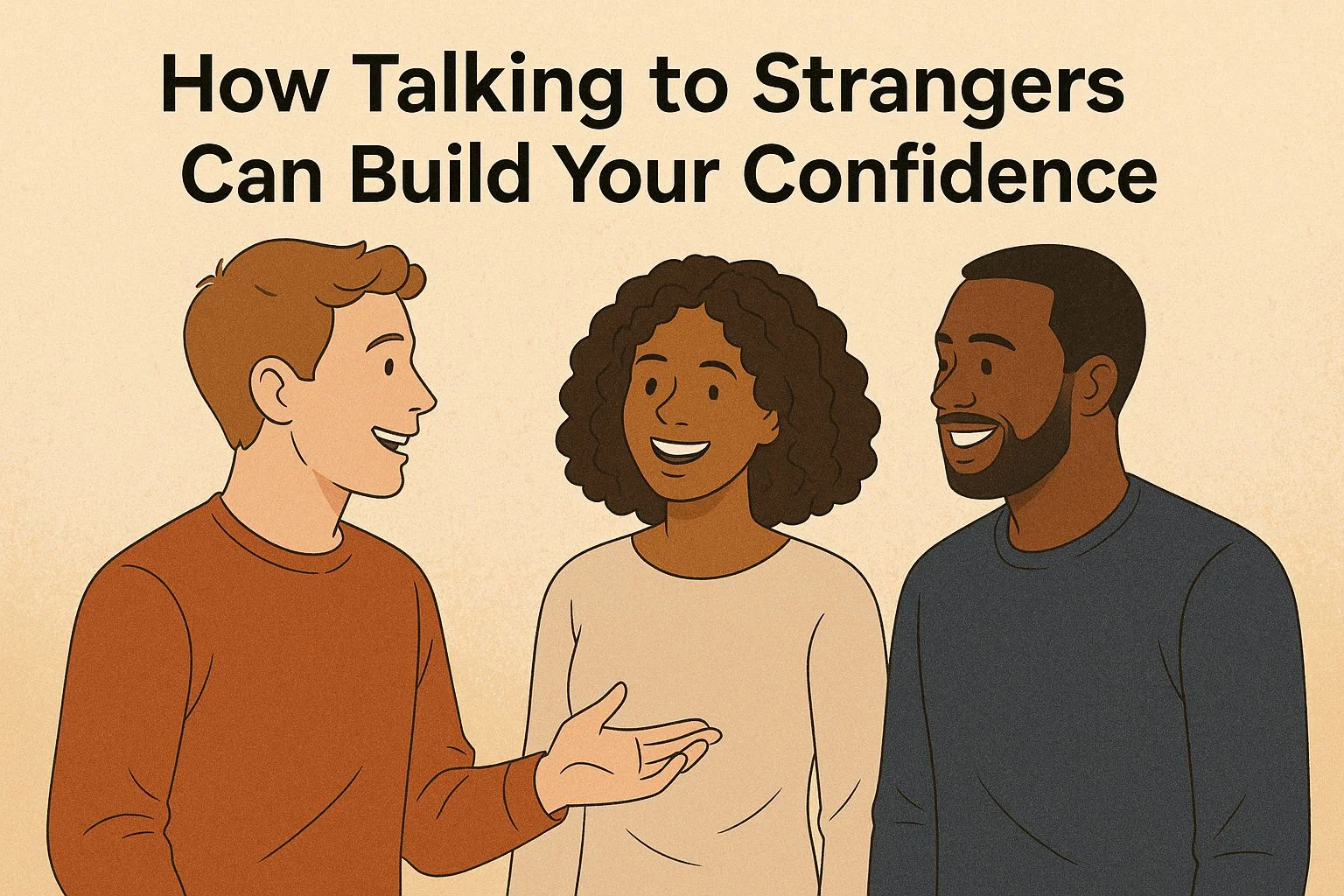
How Talking to Strangers Can Build Your Confidence
Introduction: The Power of One Simple Conversation
Confidence is not simply a personality trait that some people are born with and others lack. It can also develop through repeated experiences in which you communicate, handle uncertainty, make mistakes, and discover that you can recover from awkward moments.
Talking with unfamiliar people can provide one small opportunity to practice those skills. A short conversation with a stranger may involve introducing yourself, asking a question, listening carefully, handling an unexpected response, and deciding how to end the interaction politely.
This article looks at what research says about conversations and social connection, explains how repeated communication practice can help develop social confidence, and provides practical exercises you can try both online and offline. It also covers the limitations and safety considerations of talking to strangers online.
1. Why Talking to Strangers Matters More Than You Think
We live in a world where most communication happens behind screens — emails, texts, DMs. Yet, one of the fastest ways to develop social confidence is through real conversation with real people. Strangers, especially, offer an opportunity to practice being authentic without pressure.
1.1 What Research Says About Talking to Strangers
Research suggests that people can underestimate how positively a brief interaction with a stranger will affect their experience. Experiments discussed by University of Chicago behavioral scientist Nicholas Epley found that people who were instructed to talk with strangers during everyday commutes reported enjoying their trips more than people who stayed disconnected.
One interesting part of the research was that people often expected strangers to be less interested in talking than they actually were. In other words, the fear of bothering someone can sometimes be greater than the negative reaction that actually occurs.
Expectation: “This stranger probably doesn't want to talk.”
Research finding: People who engaged strangers often reported a more positive experience than they expected.
Source: University of Chicago News, research discussed by behavioral scientist Nicholas Epley.
In essence, social confidence grows through exposure. The more you interact, the less anxious you become about rejection or awkwardness.
Why Social Connection Matters
Talking to strangers should not be viewed as a replacement for close friendships, family relationships, or professional support. However, brief interactions can be one small way of increasing everyday social contact.
of U.S. adults surveyed by Pew said they feel lonely or isolated all or most of the time.
of U.S. adults said they have at least one close friend.
of adults with close friends said they connect with a close friend at least a few times a week.
These figures come from a nationally representative Pew Research Center survey of 6,204 U.S. adults conducted from September 3–15, 2024.
Source: Pew Research Center, “Men, Women and Social Connections,” January 2025.
1.2 Small Risks, Big Rewards
Every time you talk to someone new, you take a small emotional risk — you step outside your comfort zone. When that interaction goes well, your brain learns that risk is safe, even enjoyable. Over time, your self-image changes: from “I’m shy” to “I can connect with anyone.”
That’s the foundation of real confidence — not arrogance, but self-trust built through experience.
2. How Talking to Strangers Builds Confidence Step by Step
Confidence is like a muscle. The more you use it, the stronger it gets. Talking to strangers — whether online or in person — is one of the simplest, most natural exercises to strengthen it.
2.1 You Learn to Handle Uncertainty
When you start a conversation with a stranger, you don’t know how it will go. Maybe it’s amazing, maybe it’s awkward — and that’s okay. Learning to be comfortable with not knowing is a key part of self-assurance. You stop fearing uncertainty and start trusting your ability to adapt.
2.2 You Practice Authenticity
Strangers come in with no expectations of who you're supposed to be, which means there's no social mask to keep up and no image to protect. That freedom is refreshing on its own, and practicing that kind of authenticity tends to build real confidence faster than any scripted "confidence tips" ever could.
2.3 You Improve Communication Skills
Every new conversation can provide practice with communication skills such as tone, timing, listening, and asking questions. Online chat services can make this type of practice easier to repeat with different conversation partners.
A 7-Step Conversation Confidence Ladder
If talking to strangers feels uncomfortable, you don't need to begin with a long video conversation. Start with an interaction that feels manageable and gradually increase the difficulty.
| Level | Challenge | Goal |
|---|---|---|
| 1 | Make eye contact and smile | Become comfortable acknowledging unfamiliar people |
| 2 | Say a simple hello | Practice initiating contact |
| 3 | Ask a simple question | Practice starting a short exchange |
| 4 | Have a 2–3 minute conversation | Practice listening and responding |
| 5 | Discuss a topic you don't know much about | Practice curiosity |
| 6 | Start a longer conversation | Become comfortable with conversational flow |
| 7 | Transfer the skill to a real-world situation | Use your communication skills outside the practice environment |
Important: You do not need to complete every level in order. The purpose is to gradually practice skills that feel challenging without forcing yourself into situations that feel unsafe.
3. Overcoming the Fear of Talking to Strangers
The biggest reason people hesitate to speak to strangers is fear — fear of awkwardness, rejection, or judgment. But that fear is mostly imaginary. Once you start talking, it almost always goes better than you expect.
3.1 Rejection Doesn’t Define You
When a stranger doesn’t respond well, it’s not a reflection of you — it’s just human variety. Confidence means not needing everyone’s approval. Every “failed” conversation teaches you resilience.
What a Difficult Conversation Can Teach You
| What happens | Unhelpful interpretation | More useful interpretation |
|---|---|---|
| They give a short answer | “They don't like me.” | “They may not feel like talking right now.” |
| The conversation becomes awkward | “I'm terrible at conversations.” | “That conversation was awkward; I can try something different next time.” |
| They leave the conversation | “I failed.” | “The interaction ended. I still practiced starting it.” |
| You don't know what to say | “I'm not confident.” | “I found a skill I can practice.” |
3.2 Start Small
If you’re shy, start with manageable interactions: greet a barista, ask for directions, or compliment someone’s outfit. Online, you can practice the same skill by starting with a simple greeting and an open-ended question. Confidence develops gradually through repeated practice.
3.3 Practice in an Environment With Clear Safety Controls
Online conversation can be useful for communication practice, but anonymity does not eliminate risk. A stranger-chat platform should provide clear ways to leave a conversation, report inappropriate behavior, and block or avoid unwanted interactions where those features are available.
Technology such as automated moderation can provide an additional layer of protection, but it should never be treated as a guarantee that inappropriate behavior will not occur.
Before sharing personal information, consider whether the other person actually needs to know it. Avoid sharing passwords, verification codes, financial information, your home address, or other sensitive details with strangers.
4. The Psychology Behind Confidence Through Communication
Confidence isn’t about never feeling nervous — it’s about acting despite the nerves. Psychologists describe confidence as a byproduct of “exposure therapy” — small, repeated experiences that teach your brain that fear is manageable.
4.1 The Confidence Practice Loop
A useful way to think about social confidence is as a cycle rather than a single event.
| Step 1 | Step 2 | Step 3 | Step 4 |
|---|---|---|---|
| Try Start a conversation | Experience Notice what happens | Reflect Identify what worked | Repeat Try again with one improvement |
Not every interaction will be positive. The goal is to collect experience, learn from it, and become more comfortable with the process rather than measuring success by whether every stranger likes you.
4.2 Body Language and Self-Perception
When you talk to new people, you subconsciously practice positive body language — smiling, eye contact, open posture. These small physical habits actually boost your internal state of confidence. Your body tells your brain, “I’m capable.”
4.3 The Power of Curiosity
Confidence grows faster when your focus shifts outward. Instead of worrying about how you sound, you start wondering about the person you’re talking to. Curiosity replaces anxiety. You realize people aren’t judging you — they’re just as human and curious as you are.
Talking to Strangers Online vs. In Person
Both environments can provide communication practice, but they train slightly different skills. Online conversation can be easier to start because you control the physical environment, while in-person interactions provide additional practice with body language and real-world social cues.
| Skill | Online conversation | In-person conversation |
|---|---|---|
| Starting conversations | Easy to practice repeatedly | Requires real-world initiation |
| Voice | Can practice speaking and listening | Can practice the same skills naturally |
| Body language | Depends on the type of call and camera use | More complete physical cues |
| Cultural exposure | Can provide access to people in different locations | Usually limited by physical location |
| Personal safety | Can be practiced from a private environment, but online risks remain | Requires awareness of the physical environment |
| Transfer to daily life | Useful for speaking and listening practice | Directly practices everyday social situations |
5. How Online Chat Platforms Can Help You Practice
Online conversation platforms can provide a convenient environment for practicing communication because they make it possible to have repeated conversations with people you do not already know.
For someone who feels uncomfortable starting conversations in person, a voice or video chat can provide a different setting in which to practice introductions, questions, listening, topic changes, and polite conversation endings.
The platform itself does not create confidence automatically. The useful part is the repeated practice and reflection that happens during and after conversations.
5.1 Safe & Anonymous Conversations
Services that do not require public profiles can feel less socially demanding for some users. However, the absence of a profile does not guarantee complete anonymity or eliminate online risks.
5.2 AI Moderation for a Positive Experience
Automated moderation may help identify potentially inappropriate behavior, depending on how a service is designed. It should be treated as one layer of protection rather than a guarantee of a completely safe conversation.
5.3 Global Cultural Learning
Confidence can also grow through exposure to different perspectives. Conversations with people from other cultures can provide opportunities to listen, ask questions, and become more comfortable communicating across differences.
6. Real-World Benefits of Talking to Strangers
Beyond personal growth, confidence from talking to strangers has practical advantages in career, education, and relationships. Learn more about online friendship.
6.1 Improved Communication at Work
People who practice social confidence handle interviews, presentations, and networking better. They’ve already trained their mind to stay calm while talking to new faces.
6.2 Better Emotional Intelligence
Talking to strangers develops empathy. You start recognizing tone, expressions, and emotions quickly — skills that translate directly to better relationships.
6.3 Increased Creativity and Adaptability
When you expose yourself to new ideas and personalities, your thinking becomes more flexible. You stop fearing differences and start appreciating them — a key trait of confident, successful people.
7. A 7-Day Conversation Confidence Challenge
If you want to practice, keep the goal small. The objective is not to become extremely outgoing in one week. It is to collect seven manageable experiences with communication.
| Day | Practice | Reflection |
|---|---|---|
| 1 | Say hello to someone you don't normally talk to | How nervous were you before and after? |
| 2 | Ask one open-ended question | Did the question create a follow-up? |
| 3 | Practice active listening | What detail did you remember? |
| 4 | Have a 2–3 minute conversation | What made the conversation continue? |
| 5 | Talk about a topic you know little about | What did you learn? |
| 6 | Practice ending a conversation politely | Did you feel comfortable setting an ending? |
| 7 | Repeat your hardest activity | What feels easier than it did on Day 1? |
8. Personal Story: How Talking Online Built My Confidence
I used to dread small talk. Whether it was at parties or on video calls, I froze up. Then, I started using Wakiee — just to see what it was like. My first few conversations were short and awkward. But within a week, I started noticing something: I was less tense. I laughed more. I spoke more naturally.
By the tenth conversation, I was comfortable talking to anyone — not just online, but in real life too. I realized that confidence isn’t about being perfect; it’s about being present. Talking to strangers gave me that power.
How to Measure Your Conversation Progress
You can track social confidence without turning it into a competition. Once a week, rate how comfortable you feel with each skill on a scale from 1 to 5.
| Skill | 1 | 2 | 3 | 4 | 5 |
|---|---|---|---|---|---|
| Starting a conversation | Circle one | ||||
| Asking follow-up questions | Circle one | ||||
| Listening without planning my next sentence | Circle one | ||||
| Handling awkward pauses | Circle one | ||||
| Recovering from an awkward moment | Circle one | ||||
| Ending conversations comfortably | Circle one | ||||
Tip: Repeat the assessment after a few weeks and compare your answers. The goal is not a perfect score; it is noticing which specific skills are becoming easier.
9. Confidence Can Influence the Tone of a Conversation
The way you communicate can influence how an interaction develops. Speaking clearly, listening attentively, showing curiosity, and respecting boundaries can make conversations easier for both people.
9.1 Building a Confident Mindset
Confidence does not mean assuming every interaction will succeed. A more useful mindset is believing that you can handle different outcomes: a great conversation, an awkward conversation, a short conversation, or no conversation at all.
9.2 Helping Others Feel Comfortable
Good conversation is reciprocal. Asking thoughtful questions, giving the other person room to speak, and respecting their decision to continue or leave can make an interaction more comfortable for both sides.
10. Final Thoughts: Confidence Grows Through Practice
Talking to strangers is not a magic formula for becoming confident. What it can provide is something much more practical: repeated opportunities to practice starting conversations, listening, asking questions, handling uncertainty, and recovering from awkward moments.
Research on brief social interactions suggests that people can sometimes underestimate how positive a conversation with a stranger will be. At the same time, not every interaction will be successful, and becoming socially confident means learning to handle both positive and negative outcomes.
Online voice and video chat can provide one environment for practicing these skills. The key is to use it intentionally: start with manageable conversations, protect your privacy, respect other people's boundaries, reflect on what you learned, and gradually challenge yourself.
Confidence is not the absence of nervousness. It is the growing belief that you can participate in a conversation, handle uncertainty, and move forward even when an interaction does not go exactly as planned.